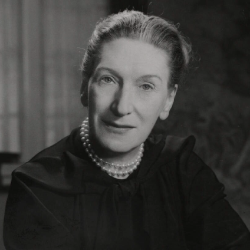
Elizabeth Bowen was an Anglo-Irish novelist and short-story writer. Her fiction often explores social unease, emotional restraint and wartime London, notably in The Death of the Heart and The Heat of the Day.
Elizabeth Bowen
The Death of the Heart
1938. Penguin, 1962.
The doyenne of Regent's Park writers lived at 2 Clarence Terrace from 1935 to 1951.
The islands stood in frozen woody brown dusk; it was now between three and four in the afternoon. A sort of breath from the clay, from the city outside the park, condensing, made the air unclear; through this, the trees round the lake soared rigidly up. Bronze sky of January bound the sky and the landscape; the sky was shut to the sun - but the swans, the rims of the ice, the pallid withdrawn Regency terraces had an unusual burnish, as though cold were light.
A slow walk around the Boating Lake takes up the whole of Chapter 1. The principal characters live at '2 Windsor Terrace' which has been identified as the author's own home in Clarence Terrace. House and park appear frequently throughout the book.
London, 1940
Reprinted in The Mulberry Tree - Writings of Elizabeth Bowen. Ed. Hermione Lee. Virago, 1986.
I had always placed this park among the most civilized scenes on earth; the Nash pillars look as brittle as sugar - actually, which is wonderful, they have not cracked; though several of the terraces are gutted...Just inside the gates an unexploded bomb makes a boil in the tarmac road... The RE "suicide squad" detonate, somewhere in the hinterland of the park, bombs dug up elsewhere...
Air raids in World War Two had caused the park to be closed because of time bombs; further damage to the houses meant that after the war the author's Clarence Terrace home would be demolished and rebuilt. See the Anne Thackeray Ritchie entry for a description of the house and park in wartime. The novelist Anthony Powell recalled going there for a snack after an unsatisfactory dinner at her neighbour Cyril Connolly (this was before the demolition). She 'rarely wore spectacles, and perhaps did not see very clearly without them', and never seemed to see the cockroaches in the kitchen that neighbours complained of in other Regent's Park houses. The kitchen floor was 'writhing' with them (Faces In My Time).
The Heat of the Day
1948. Vintage, 1998.
from where it was being played at the base of this muffled hollow the music could not travel far through the park - but hints of it that did escape were disturbing: from the mound, from the rose gardens, from the walks round the lakes people were being slowly drawn to the theatre by the sensation that they were missing something
Chapter One describes a Sunday concert at the Open Air Theatre in September, 1942. What Louie is missing is her soldier husband: Regent's Park is where she goes to find male company, and the concert is as good a place as any.
from the Sunday park the illusory sensuous veil was stripped - one saw clean through the thickets into empty distance; the ilexy love mound rode in a waste of lawn like a ship abandoned; strangers gave one another unmeeting looks. Habituated lovers made the park tour briskly and arm-in-arm; along black paths and round more sheltered seats she overheard chatter of that existence which was the secret of everybody except her...Yes, it was in the disenchanted park that London's indifference to Louie stood out most stark and bare
Later, as winter approaches, the opportunities lessen.
The Man of the Family
In The Collected Stories of Elizabeth Bowen. Penguin Books, 1983. Reprinted from The Cat Jumps (Gollancz, 1934).
Pretty Rachel sat smiling into the bowl of glass fruit, on which green sunshine, reflected back from the Regent's Park trees, twinkled and slid. The trees were in full June light, the dining-room in shadow ...William always lunched at his Aunt Luella's on his way across London. The Regent's Park house was his pied-à-terre.
After lunch Rachel insists on being escorted.
I think Regent's Park's so shady; one never knows. Last time I got spoken to by a boy on a scooter, and today I was followed by a repulsive Airedale. We parted out on the doorstep; it's probably waiting still
Tears, Idle Tears
In The Collected Stories of Elizabeth Bowen. Penguin Books, 1983. Reprinted from Look At All Those Roses (Gollancz, 1941).
Frederick burst into tears in the middle of Regent's Park. His mother, seeing what was about to happen, had cried: "Frederick, you can't - in the middle of Regent's Park!" Really, this was a corner, one of those lively corners just inside a big gate, where two walks meet and a bridge starts across the pretty, winding lake...May sun spattered gold through the breezy trees; the tulips though falling open were still gay; three girls in a long boat shot under the bridge.
Frederick's mother, an emotionally frozen war widow, walks off, forbidding him to join her 'till you've stopped that noise.' The miserable seven-year-old finds solace in a duck that 'sat folded into a sleek white cypher on the green, grassy margin of the lake.' As he approaches, the duck enters the lake; 'its lovely white-china body balanced on the green glass water as it propelled itself gently round the curve of the bank. Frederick saw with a passion of observation its shadowy webbed feet lazily striking out'.
I Hear You Say So
In The Collected Stories of Elizabeth Bowen. Penguin Books, 1983. Reprinted from New Writing and Daylight, September 1945.
A week after V.E. Day, the nightingale came to London - un-noticed until it began to sing...It was now about half past ten; the rose garden in the centre of the park had been closed and locked, leaving the first roses to smoulder out unseen as dark fell...The waterbirds one by one were drawing in to settle among the dock leaves round the islands. The water, which had dulled as the sky faded, now began to shed, as though it were phosphorescent, ghostly light of its own.
It has an unsettling effect on the park's visitors.
Unseen rays of night pinpointed the nightingale, in the concentrated and somehow burning blackness of its unknown tree. It sang into incredulity like the first nightingale in Eden...It sang from a planet, beyond experience, drawing out longings, sending them back again frozen, piercing, not again to be borne