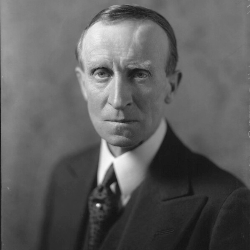
John Buchan, later 1st Baron Tweedsmuir, was a Scottish novelist, historian, publisher and politician, best known as the author of The Thirty-Nine Steps.
John Buchan
The Path of the King
1920. Cedric Chivers Ltd., 1974.
Lovel had followed him up through Covent Garden, across the Oxford road, and into the Marylebone fields. There the magistrate's pace had slackened, and he had loitered like a truant schoolboy among the furze and briars...Now was the chance for the murderer lurking in the brambles. It would be easy to slip behind and give him the sword-point. But Mr. Lovel tarried. It may have been compunction, but more likely it was fear. It was also curiosity, for the magistrate's face, as he passed Lovel's hiding-place, was distraught and melancholy. Here was another man with bitter thoughts - perhaps with a deadly secret. Whatever the reason he let the morning go by
The year is 1678 and the magistrate is Sir Edmund Berry Godfrey, an historical figure whose murder has remained unsolved to this day (see the Jeremy Potter entry for a non-fiction account of the incident). Lovel fears the magistrate will uncover his treasonous past, but is unaware that - in this version of events - Godfrey's death has already been decided on as part of Titus Oates's 'Popish Plot'. He continues to follow the magistrate, waiting for an opportunity, but 'then came mischance. First one, then another of the Marylebone cow-keepers blocked the lane with their driven beasts. The place became as public as Bartholomew's Fair.' The author moved to Portland Place in 1912; it was from here that his most famous character, Richard Hannay, set out to solve the mystery of The Thirty-Nine Steps.
The Three Hostages
1924.
I went up Portland Place, past the Regent's Park,
In The Three Hostages Hannay has adventures in Marylebone and Gospel Oak; on his way to the latter, this is all we get.