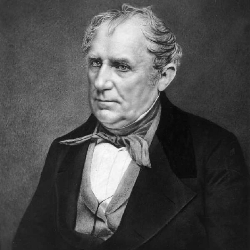
James Fenimore Cooper was an American novelist best known for The Last of the Mohicans and the Leatherstocking Tales.
James Fenimore Cooper
Gleanings in Europe: England
1837. University of New York Press, c1982.
The mists, when they do not degenerate into downright smoke and fogs, have the merit of singularly softening and aiding the landscape character of its scenes. I have driven into the Regent's Park, when the fields, casting upward their hues, the rows of houses seen dimly through the haze, the obscure glimpses of the hills beyond, the carriages rolling up, as it were out of vacuum, and the dim magnificence with its air of vastness, have conspired to render it one of the most extraordinary things, in its way, I have ever beheld
The author of The Last of the Mohicans had arrived at Dover in 1828, on his fourth visit to England, and his gleanings took the form of letters home. 'This park better deserves the name of garden', he confided; 'it bids fair to be very beautiful, but is still too recent to develope all its rural charms'. He was noncommittal about the Nash terraces but noted that the park was in 'a quarter inhabited by the upper classes, for, while London has so many areas for the enjoyment of the affluent, it is worse off than common, in this respect, in the quarters of the humble'. And though less vehement than Maria Edgeworth about the appearance of the buildings, he shared her view of their impermanence:
Were London to fall into ruins, there would probably be fewer of its remains left in a century than are now to be found of Rome. All the stuccoed palaces, and Grecian facades of Regent's-street and Regent's Park, would dissolve under a few changes of the season