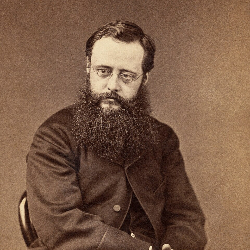
Wilkie Collins was an English novelist and playwright best known for the sensation novels The Woman in White and The Moonstone.
Wilkie Collins
Basil
1852. Dover, 1980.
Lived at 17 Hanover Terrace from 1850 to 1857.
I left Hollyoake Square at once, and walked into the Regent's Park, the northern portion of which was close at hand
The hero wanders around the park in a daze after the first sight of his beloved, who lives nearby. Despite daily visits for a year there is only one more mention:
Further on the Park trees came in sight - trees that no autumn decay or winter nakedness could make dreary, in the bygone time: for she and I had walked under them together
The Woman in White
1859. Everyman, 1963.
Although there are no descriptions of the park (there are two walks alongside the western perimeter) I have included this book because for a long time it was thought that the dramatic first appearance of the heroine was based on a real-life incident. Collins was said to have encountered a young woman fleeing from a villa in the park, where she had been imprisoned. The source for this was J.G. Millais's biography of his father, The Life and Letters of Sir John Everett Millais. Modern biographers of Collins say it's nonsense.
some dilapidated volumes...a sort of French Newgate Calendar...in them I found some of my best plots
Kenneth Robinson, in Wilkie Collins: A Biography, quotes Collins on the genesis of the novel. On a visit to Paris he found these volumes, Maurice Mejan's Recueil des Causes Celebres. Collins expressly cited the plot of The Woman in White, and though later in life he offered other explanations the points of similarity, even to the detail of the white dress, are too marked to be dismissed as mere coincidence.
Armadale
1864. Penguin Classics, 1955.
Lydia Gwilt - bigamist, husband-poisoner and laudanum addict - arranges to meet Ozias Midwinter in the park to avoid being seen with him by her landlady. And again the next day.
Man and Wife
1870. World Classics/OUP, 1995.
I had had a terrible night...I went out to see what the air and the sunshine and the cool green of trees and grass would do for me. The nearest place in which I could find what I wanted was the Regent's Park. I went into one of the quiet walks in the middle of the park, where the horses and carriages are not allowed to go, and where old people can sun themselves, and children play, without danger. I sat me down to rest on a bench. Among the children near me was a beautiful little boy, playing with a brand-new toy - a horse and wagon. While I was watching him busily plucking up the blades of grass and loading his wagon with them, I felt for the first time - what I have often and often felt since - a creeping chill come slowly over my flesh, and then a suspicion of something hidden near me, which would steal out and show itself if I looked that way.
Ann Silvester has supped her full of horrors in the course of this marathon of marital skulduggery, but it's all been in a good cause. The author explains in a foreword that he wants to draw attention to 'the present scandalous condition of the Marriage Laws' and the abuses 'which have been too long suffered to exist among us unchecked.' The plot is far too complicated to explain how this is linked to Ann's present sufferings, but they aren't over yet.
There was a big tree hard by. I looked toward the tree, and waited to see the something hidden appear from behind it. The Thing stole out, dark and shadowy in the pleasant sunlight. At first I saw only the dim figure of a woman. After a little it began to get plainer, brightening from within outward - brightening, brightening, brightening, till it set before me the vision of MY OWN SELF...I saw it move over the grass. I saw it stop behind the beautiful little boy. I saw it stand and listen...for the chiming of the bell before the clock struck the hour. When it heard the stroke it pointed down to the boy with my own hand; and it said to me, with my own voice, "Kill him."