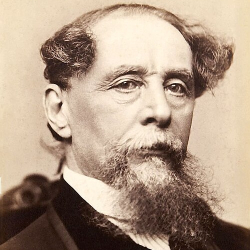
Charles Dickens was an English novelist and social critic, widely regarded as one of the defining writers of the Victorian age.
Charles Dickens
Sketches By Boz
1833-1836.
Lived intermittently at 1 Devonshire Terrace (now the corner of Marylebone Road and Marylebone High Street) from 1839 to 1851.
The eponymous hero of A Passage In the Life of Mr. Watkins Tottle drowns himself in the Regent's Canal after a tragicomic misunderstanding about a forthcoming marriage.
David Copperfield
1849.
see the lions for an hour or two
Steerforth (future seducer of Little Em'ly) suggests this - presumably at the Zoo - on their way to Highgate. They also visit a 'Panorama' and 'took a walk through the Museum'. Both attractions were probably in the Colosseum, on the site where Cambridge Gate now stands. Various characters at various times stay at addresses in the Camden Town neighbourhood, as Dickens had as a child, but there are no references to the park.
The Uncommercial Traveller
This was a persona created in 1860 to link miscellaneous articles for his magazine All The Year Round.
I was walking in from the country, on the northern side of the Regent's Park - hard frozen and deserted - when I saw an empty Hansom cab drive up to the lodge at Gloucester-gate, and the driver with great agitation call to the man there.
Chapter XIX - Some Recollections of Mortality - recounts an incident in 'the hard winter' of 1861. The body of a young woman has been pulled out of the canal at the bridge 'near the cross-path to Chalk Farm.' This 'forlorn spectacle' is made more horrifying by the callous behaviour of a passing bargeman and his wife, who would have walked their horse right over the body on the towpath if the onlookers had not shouted at them.
As an addition to my composure, I ran over a little dog in the Regent's Park yesterday (killing him on the spot) and gave his little mistress - a girl of thirteen or fourteen - such exquisite distress as I never saw the like of.
In Claire Tomalin's biography of the actress Ellen Ternan, who became Dickens's secret mistress, his reactions to this incident are linked to his guilty feelings about the young woman he was hoping to seduce. An earlier intimation of mortality was recorded in a letter of 2nd March 1846.
The blaring use of the very worst language possible, in our public thoroughfares - especially in those set apart for recreation - is another disgrace to us...Years ago, when I had a near interest in certain children who were sent with their nurses, for air and exercise, into the Regent's Park, I found this evil to be so abhorrent and horrible there, that I called public attention to it, and also to its contemplative reception by the Police
Chapter XXX - The Ruffian - castigates 'constabular contemplation', i.e. the police turning a blind eye to 'ruffianism'. Margaret Baillie-Saunders (The Great Folk of Old Marylebone, 1904) says of the ruffianism: 'his own little children and their nurses could not take a walk there without insult and molestation from tramping women and girls - an evil he was the means of eventually putting down by untiring appeals to the press and continual police court charges'.