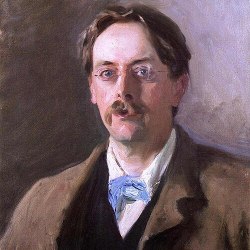
Edmund Gosse was an English critic, literary historian, translator and memoirist, best known for Father and Son.
Edmund Gosse
Father and Son
1907. William Heinemann, 1948.
Lived at 17 Hanover Terrace from 1901 to 1928.
My Father, after a little reflection, proposed to take me to Primrose Hill. I had never heard of the place, and names have always appealed directly to my imagination. I was in the highest degree delighted, and could hardly restrain my impatience...I expected to see a mountain absolutely carpeted with primroses...
The author, a biographer and critic best known now for this autobiography, was born in 1849 and aged about six at the time of the incident he is recounting. After 'a sort of fit of hysterics' brought on by his attempts to discover the secrets of 'natural magic', he had convinced his father that he needed to 'go into the country' to recuperate.
But at length, as we walked from the Chalk Farm direction, a miserable acclivity stole into view - surrounded, even in those days, on most sides by houses, with its grass worn to the buff by millions of boots, and resembling what I meant by "the country" about as much as Poplar resembles Paradise. We sat down on a bench at its inglorious summit, whereupon I burst into tears, and in a heart-rending whisper sobbed, "Oh! Papa, let us go home!"
The Life and Letters of Sir Edmund Gosse
Evan Charteris. William Heinemann, 1931.
The horse-chestnuts, vast candelabra crowded with creamy candles - and the grace of the leaves, and the flash of the waters, and the soft blue sky, and the pink blouses of the far-away young ladies disporting on the lake! Talk not to me of your rural scenes. Regent's Park beats the lot of them
Gosse is describing the view from his favourite writing place, a 'capacious balcony' overlooking the lake. Earlier, while living in Delamere Terrace W2, he had written:
I stepped across the Park this morning in an ecstasy. There was a silver bloom upon the grass, the sun was walking through real blue sky...
This must have inspired him to move there: on 8th April 1901 he wrote, 'I have bought a house! It is a large solid house in an old Georgian Terrace jutting into and overlooking Regent's Park. It is a good deal out of repair... The situation and outlook are delightful; there is no view in London more beautiful than from our upper windows. There is a vast balcony where we hope to live entirely in summer, where I shall work by day, and sit on fine nights with the electric light delicately shaded, and enjoy long talks...'
Tessa [his daughter] took me into the garden of South Lodge, which we explored in every corner...it is charming, and at the back there is a deserted walk, most romantic, like a beautiful lane somewhere deep in the country. When we came back, the nursery-maids and Sunday walkers had all disappeared, so we sat quite alone on that bench in the further enclosure where you and I sit, close to the water, and opposite the sparrows' new [illegible]. There we had the delight of seeing a kingfisher! He was fishing further up the water, where the foliage is so thick, and we saw him dive down on the water from the over-hanging boughs at least thirty times. He was in brilliant plumage, and seemed perfectly at home. Where can he have come from?
Describing one of his 'usual Sunday walks' in a letter to his wife. (See the Alfred Noyes entry for a warning against having Gosse as a neighbour.)