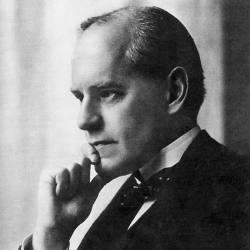
John Galsworthy was an English novelist and playwright, best known for The Forsyte Saga and winner of the 1932 Nobel Prize in Literature.
John Galsworthy
The Man Of Property
William Heinemann, 1906.
Lived at 8 Cambridge Gate from 1887 to 1899.
He decided to commence with the Botanical Gardens, where he had already made so may studies, and chose the little artificial pond, sprinkled now with an autumn shower of red and yellow leaves, for though the gardeners longed to sweep them off, they could not reach them with their brooms. The rest of the gardens they swept bare enough, removing every morning Nature's rain of leaves... The gravel paths must lie unstained, ordered, methodical, without knowledge of the realities of life
It is Autumn, 1887, and as Young Jolyon starts to set up his easel he realizes that the woman sitting on a nearby bench is Irene Forsyte, waiting for her lover. Her striking beauty has not gone unremarked by other visitors.
Two young gentlemen of that peculiar breed, at once forward and shy, found in the Regent's Park, came by on their way to lawn tennis, and he noted with disapproval their furtive stares of admiration. A loitering gardener halted to do something unnecessary to a clump of pampas grass; he, too, wanted an excuse for peeping. A gentleman, old, and, by his hat, a professor of horticulture, passed three times to scrutinize her long and stealthily, a queer expression about his lips
Another rendezvous in the park, Young Jolyon and his children meeting grandfather at the Zoo, is depicted in Part 2, Chapter 6.
The Freelands
1915. Thomas Nelson & Sons (undated).
A policeman put them right for Portland Place. Half past one! And it would be dawn soon after three! They walked soberly again now into the outer circle of Regent's Park; talked soberly, too, discussing sublunary matters, and every now and then, their arms, round each other, gave little convulsive squeezes. The rain had stopped and the moon shone clear; by its light the trees and flowers were clothed in colours whose blood had spilled away; the town's murmur was dying, the house lights dead already.
After an evening at the opera Derek and Nedda have set out to walk to Hampstead, timing themselves to catch the sun rising over the Heath.
They came out of the park into a road where the latest taxis were rattling past; a face, a bare neck, silk hat, or shirt-front gleamed in the window-squares, and now and then a laugh came floating through. They stopped to watch them from under the low-hanging branches of an acacia-tree, and Derek, gazing at her face, still wet with rain, so young and round and soft, thought: "And she loves me!"
Saint's Progress
1919. Heinemann, 1924.
Coming off duty at that very moment, Leila Lynch decided to have her hour's walk before she went home. She was in charge of two wards, and as a rule took the day watches; but some slight upset had given her this extra spell... In this desert of the dawn she let her long blue overcoat flap loose...Though she could not see herself, she appreciated her appearance, swaying along like that, past lonely trees and houses. A pity there was no one to see her in that round of Regent's Park... walking in meditation, enjoying the colour coming back into the world, as if especially for her
Leila is working at a VAD hospital in St. John's Wood, nursing the wounded of World War One. Twice married but now on her own, she has been looking over some old love letters which have 'sharpened to poignancy the feeling that life was slipping away from her while she was still comely.'
Her wheel of Regent's Park was coming full circle, and the sun was up behind the houses, but still no sound of traffic stirred. She stopped before a flower-bed where was some heliotrope, and took a long, luxurious sniff: she could not resist plucking a sprig, too, and holding it to her nose. A sudden want of love had run through every nerve and fibre of her; she shivered, standing there with her eyes half closed, above the pale violet blossom