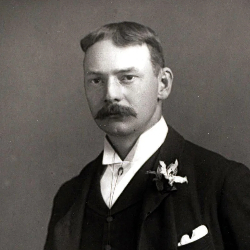
Jerome K. Jerome was an English writer and humorist best known for Three Men in a Boat.
Jerome K. Jerome
Paul Kelver
Hutchinson, 1903.
Have you forgotten, Tubby, our secret camping ground beside the lonely waters of the Regent's Park canal, where discussing our frugal meal of toasted elephant's tongue - by the uninitiated mistakable for jumbles - there would break upon our trained hunter's ear the hungry lion or tiger's distant roar, mingled with the melancholy, long-drawn growling of the polar bear, growing ever in volume and impatience until half-past four precisely; and we would snatch our rifles, and with stealthy tread and every sense alert make our way through the jungle - until stopped by the spiked fencing round the Zoological Gardens?
In this autobiographical novel the narrator is recalling childhood days - earlier he describes a confrontation with an errand boy who barred his way 'just as we were about to enter Regent's Park by the wicket opposite Hanover Gate', and challenges him to a fight. Worse things happen in later life: an entrepreneur who persuaded him to invest in a play has 'bolted and taken the week's money with him', making Paul a bankrupt and precipitating a nervous breakdown.
One night, a week or two after my partial recovery, I had wandered on and on for hour after hour. The breaking dawn recalled me to myself. I was outside the palings of a park. In the faint shadowy light it looked strange and unfamiliar. I was too tired to walk further. I scrambled over the low wooden fencing, and reaching a seat, dropped down and fell asleep...Suddenly I started to my feet. Norah's strong hand drew me down again. I was in the broad walk, Regent's Park, where, I remembered, Norah often walked before breakfast. A park-keeper, the only other human creature within sight, was eyeing me suspiciously. I saw myself - without a looking-glass - unkempt, ragged ...Ashamed of my weakness, ashamed of everything about me, I burst into tears...The park-keeper, satisfied, I suppose, that at all events I was not dangerous, with a grin passed on.
The Fawn Gloves
From Malvina In Brittany. Cassell & Co., 1916.
All down the Broad Walk and across Primrose Hill, he saw her silhouetted against the sinking sun. At least that much of her: the wistful face and the trim brown shoes and the little folded hands; until the sun went down behind the high chimneys of the brewery beyond Swiss Cottage, and then she faded.
In this short story a clerk walking home across the park each evening is intrigued by the 'plainly dressed, childish-looking figure' who is always sitting alone on a park bench. He strikes up an acquaintance, speculates on her history and situation, and gradually becomes obsessed by her.
The twilight had almost faded, and, save for the broad back of a disappearing policeman, they had the Outer Circle to themselves; and, the sudden impulse coming to him, he dropped on one knee, as they do in plays and story books and sometimes elsewhere, and pressed the little fawn gloves to his lips in a long passionate kiss.
But the fawn gloves conceal a secret, and the romance ends in tragedy.
My Life and Times
1926. Folio Society, 1992.
My way led by Primrose Hill and across Regent's Park. Primrose Hill was then on the outskirts of London, and behind it lay cottages and fields...Sometimes of a morning I was lucky enough to strike a carriage going round the outer circle of the park, and would run after it and jump on to the axle-bar. But clinging on was ticklish work, especially when handicapped by a satchel and an umbrella; added to which there was always the danger of some mean little cuss pointing from the pavement and screaming "Whip behind", when one had to spring off quickly, taking one's chance of arriving upon one's feet or one's sitting apparatus.
In 1869, aged ten, the author started at the Philological School in Lisson Grove, a two-hour train journey from his home in Poplar. Memories of his school days appear lightly disguised in Paul Kelver.
It was one Dan of the lower third who first disturbed my religious beliefs. He came from the neighbourhood of Camden Town, and generally we would meet in the outer circle, and walk together across the park.
Jerome confided that he had been praying for success in the forthcoming maths exam; Dan wondered whether this wasn't cheating - shouldn't he rely on his own efforts rather than divine intervention?
Three Men in a Boat
1889. Penguin Classics, 1999.
The author's best-known book describes the boating party 'chatting about our rowing experiences...'
My own earliest boating recollection is of five of us contributing three-pence each and taking out a curiously constructed craft on the Regent's Park lake, drying ourselves subsequently in the park-keeper's lodge.