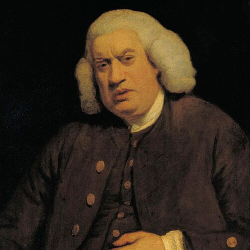
Samuel Johnson was an English critic, essayist, poet, biographer and lexicographer, best known for A Dictionary of the English Language.
Samuel Johnson
Boswell's Life of Johnson
Ed. G.B. Hill, revised L.F. Powell. OUP Clarendon Press, 1934. 6 vols.
Dr. Johnson once assumed a character in which perhaps even Mr. Boswell never saw him. His curiosity having been excited by the praises bestowed on the celebrated Torre's fireworks at Marybone-Gardens, he desired Mr. Steevens to accompany him thither. The evening had proved showery; and soon after the few people present were assembled, publick notice was given, that the conductors to the wheels, suns, stars, &c., were so thoroughly water-soaked, that it was impossible any part of the exhibition should be made.
"This is a mere excuse, (says the Doctor,) to save their crackers for a more profitable company. Let us but hold up our sticks, and threaten to break those coloured lamps that surround the Orchestra, and we shall soon have our wishes gratified. The core of the fireworks cannot be injured; let the different pieces be touched in their respective centers, and they will do their offices as well as ever." Some young men who overheard him, immediately began the violence he had recommended, and an attempt was speedily made to fire some of the wheels which appeared to have received the smallest damage; but to little purpose were they lighted, for most of them completely failed. The authour of The Rambler, however, may be considered, on this occasion, as the ringleader of a successful riot, though not as a skilful pyrotechnist.
No date is given for this incident, but it would have been between 1772 and 1774. He is said to have made a second visit, which may have inspired one of his 'lost' literary works. In a biographical sketch in The Gentleman's Magazine (December 1874) Thomas Tyers wrote, 'On the fireworks of Torri he wrote a Latin poem.' It has since disappeared, but happily another poem on the subject, by Silipo , has survived.
Couid'st thou resign the Park and Play content,
For the fair Banks of Severn or of Trent...
Johnson went to live at 6 Castle Street, Cavendish Square, half a mile away, soon after he returned to London in 1738. In the same year he wrote London: A Poem, and in these lines it is tempting to see a reference to Marylebone Park, where the Gardens were situated. A.D. Webster, in The Regent's Park and Primrose Hill (1911), says that 'the great lexicographer...was a frequent visitor to the Park', but I have not been able to find any other references.