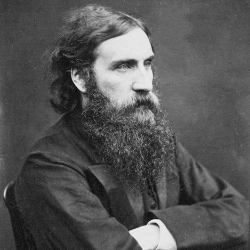
George MacDonald was a Scottish novelist, poet and Congregational minister, known for fantasy, children's fiction and Christian allegory.
George MacDonald
At the Back of the North Wind
1871. Puffin Books, 1994.
They were now climbing the slope of a grassy ascent. It was Primrose Hill, in fact, although Diamond had never heard of it. The moment they reached the top, North Wind stood and turned her face towards London. The stars were still shining clear and cold overhead. There was not a cloud to be seen. The air was sharp, but Diamond did not find it cold. "Now," said the lady, "whatever you do, do not let my hand go."... As she stood looking towards London, Diamond saw that she was trembling. "Are you cold, North Wind?" he asked. "No, Diamond," she answered, looking down upon him with a smile; "I am only getting ready to sweep one of my rooms. Those careless, greedy, untidy children make it in such a mess"
Herodotus, the author tells us, said that the people who lived at the back of the north wind were so comfortable that they could not bear it any longer, and drowned themselves. But this will be quite a different story, about a small boy who was called Diamond after his coachman father's favourite horse. North Wind came to see him one night with an invitation to join her on her travels.
The next moment he was rising in the air. North Wind grew towering up to the place of the clouds. Her hair went streaming out from her, till it spread like a mist over the stars. She flung herself abroad in space...The earth was rushing past like a river or a sea below him. Trees and water and green grass hurried away beneath. A great roar of wild animals rose as they rushed over the Zoological Gardens, mixed with a chattering of monkeys and a screaming of birds; but it died away in a moment behind them. And now there was nothing but the roofs of houses, sweeping along like a great torrent of stones and rocks. There was a great roaring, for the wind was dashing against London like a sea
Wilfrid Cumbermede
Hurst and Blackett, 1872. 3 vols.
One lovely evening in Spring...drew me out to the park, where the trees were all in young leaf, each with its shadow stretching away from its foot, like its longing to reach its kind across dividing space...The workmen were at that time busy about the unfinished botanical gardens, and I wandered thitherward, lingering about...I was at length sauntering slowly home...when something about a young couple in front of me attracted my attention. They were walking arm in arm, talking eagerly, but so low that I heard only a murmur. I did not quicken my pace, yet was gradually gaining upon them, when suddenly the conviction started up in my mind that the gentleman was Charley
The young lady turns out to be Clara, with whom Wilfrid was once in love, and who, he later discovers, has contrived to blacken his character in furtherance of a plot concerning the inheritance of Moldwarp Hall. Clara subsequently writes to him asking for a meeting, somewhere where they will not be overheard. For reasons he's not entirely sure of – 'was it from a suggestion of Satan, from an evil impulse of human spite, or by the decree of fate' – he suggests Regent's Park.
After an early dinner [I] sauntered out to the Zoological Gardens, to spend the time till the hour of meeting. But there, strange to say, whether from insight or fancy, in every animal face I saw such gleams of a troubled humanity that at last I could bear it no longer, and betook myself to Primrose Hill. It was a bright afternoon, wonderfully clear, with a crisp frosty feel in the air. But the sun went down, and one by one, here and there, above and below, the lights came out and the stars appeared, until at length sky and earth were full of flaming spots, and it was time to seek our rendezvous
But the rendezvous is not as secluded as Wilfrid thought and they are overheard, with fateful consequences later.
The Marquis of Lossie
1877. Cassell, 1927.
From Mr. Graham's lodging to the northeastern gate of the Regent's Park, the nearest way led through a certain passage, which, although a thoroughfare, to persons on foot, was little known. Malcolm had early discovered it, and always used it. Part of this shortcut was the yard and back-premises of a small public-house. It was between eleven and twelve when he entered it for the second time that night. Sunk in thought and suspecting no evil, he was struck down from behind, and lost his consciousness. When he came to himself he was lying in the public-house, with his head bound up, and a doctor standing over him, who asked him if he had been robbed. He searched his pockets, and found that his old watch was gone, but his money left
A sinister plot lurks behind this apparently straightforward robbery, as Malcolm begins to suspect. A man he 'half thought he had seen before', and 'did not like the look of,' offers to see him home; Malcolm accepts, 'hoping to get on the track of something thereby.'
As soon as they entered the comparative solitude of the park, he begged his companion, who had scarcely spoke all the way, to give him his arm, and leaned upon it as if still suffering, but watched him closely. About the middle of the park, where not a creature was in sight, he felt him begin to fumble in his coat-pocket, and drew something from it. But when, unresisted, he snatched away his other arm, Malcolm's fist followed it, and the man fell, nor made any resistance while he took from him a short stick, loaded with lead, and his own watch, which he found in his waistcoat-pocket. Then the fellow rose with apparent difficulty, but the moment he was on his legs, ran like a hare
The Sheep and the Goat
From The Poetical Works of George MacDonald. Vol. 1. Chatto & Windus, 1915.
...In Regent's Park, one cloudless day,
An overdriven sheep,
Come a hard, long, and dusty way,
Throbbing with thirst and hotness lay,
A panting woollen heap.But help is nearer than we know
For ills of every name:
Ragged enough to scare the crow,
But with a heart to pity woe,
A quick-eyed urchin came.Little he knew of field or fold,
Yet knew what ailed; his cap
Was ready cup for water cold;
Though creased, and stained, and very old,
'Twas not much torn, good hap!Shaping the rim and crown he went,
Till crown from rim was deep;
The water gushed from pore and rent,
Before he came one half was spent –
The other saved the sheep.O little goat, born, bred in ill,
Unwashed, half-fed, unshorn,
Thou to the sheep from breezy hill
Wast bishop, pastor, what you will,
In London dry and lorn! ...