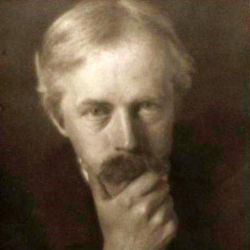
Born: 28 February 1865, Milford Haven, Pembrokeshire, Wales
Died: 22 January 1945, Wittersham, Kent, England
Nationality: British
Arthur Symons was a British poet, critic, translator, and editor, closely associated with the Decadent and Symbolist movements. His critical work The Symbolist Movement in Literature influenced literary modernism.
Arthur Symons
Extracts from the Journal of Henry Luxulyan
In Spiritual Adventures. 1905. Reprinted in Vol. 5 of The Collected Works of Arthur Symons. Martin Secker, 1924.
April 17...I have been walking in Regent's Park, the nearest country, and I feel singularly good, wise and happy. That uninteresting park, uninteresting in itself, has a gift of refreshment, as one turns into it out of the streets. I find myself leaning against the railing to watch a little dark creature with red legs and a red bill that swims between the swans, and clambers up on the grass, and runs about there stealthily, with a shy grace. There is an island, to which all the water-birds go, and it is grown over with trees and bushes and green weeds, down to the edges of the water, and they go there when they want to be alone, as one goes into a deep wood, out of the streets in which people stare.
Henry had put most of his money into the Argonaut Building Society, which has failed. 'I am ruined; what am I to do? I shall have to earn my living, heaven knows how.' Unable to work or think, he has gone for a walk in the park.
Today I was perfectly happy, merely walking about the park. I sat under a tree for half an hour, and it was only when I realised that a queer sound which had come to me at intervals, a mournful and deep cry, which I had heard in a kind of dream, was the crying of the wild beasts, over yonder, inside their bars, that I got up and came away
London: A Book of Aspects
1909. Privately printed for Edmund D. Brooks and his Friends.
I have never been able to love Regent's Park, though I know it better than the others, and though it has lovely water-birds about the islands, and though it is on the way to the Zoological Gardens. Its flowers are the best in London, for colour, form, and tending. You hear the wild beasts, but no city noises. Those sounds of roaring, crying, and the voices of imprisoned birds are sometimes distressing, and are perhaps one of the reasons why one can never be quite happy or aloof from things in Regent's Park. The water there is meagre, and the boats too closely visible; the children are poorer and seem more preoccupied than the children in the western parks. And there is the perplexing inner circle, which is as difficult to get in or out of as its lamentable namesake underground. Coming where it does, the park is a breathing-place, an immense relief; but it is the streets around, and especially the Marylebone Road, that give it its value