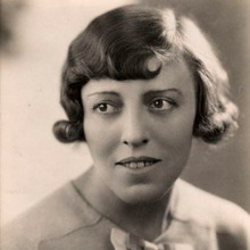
Born: 3 May 1896, Whitefield, Lancashire, England
Died: 24 November 1990, Uttlesford, Essex, England
Nationality: English
Dodie Smith was an English novelist and playwright, best known for I Capture the Castle and The Hundred and One Dalmatians.
Dodie Smith
Look Back With Mixed Feelings
Vol. 2 of an autobiography. W.H. Allen, 1978.
I didn't feel sleepy. I felt in need of fresh air. I would walk all the way home, cutting across Regent's Park. I would really look at the spring, try to feel in touch with it, count my blessings, realize my happiness...It wasn't that I was unhappy, it was just that my brain felt woolly, not quite alive; that was why I was having such trouble in playing the clean-cut Dolly. If only I could get my thoughts clear
Best known now for The Hundred and One Dalmatians, the author first achieved fame with her plays, notably Dear Octopus (1938). Earlier she had struggled to make a career as an actress, including on one occasion appearing as Dolly in Bernard Shaw's play You Never Can Tell.
And suddenly I did, when I came to some blossoming trees in Regent's Park. I stood there gazing at them and knew I was happy, just as happy as the day when I had run out to get the passport photograph taken. My trouble had just been tiredness. I would go back to the Club and sleep. But it was early yet, still daylight. I would walk slowly across the park, enjoying every minute of it
One early autumn morning I got up to find the kind of day that tempted me to walk right round the inner circle of Regent's Park. "Tempted" is the right word because the three-mile walk was hard on shoe-leather; I had no solid walking shoes. The weather was sparkling, stimulating, and just chilly enough to suggest the end of summer. I found myself planning the kind of clothes I would have for the winter - if only I had some money
The author was then living at the Three Arts Club, a girls' hostel in Marylebone Road. 'Inner circle' must be a slip of the pen: it is the Outer Circle that has a three-mile radius.
Look Back With Astonishment
Vol. 3 of an autobiography. W.H. Allen, 1979.
Ever since my girlhood at the Three Arts Club I had longed for a house on the Outer Circle of Regent's Park and now we found one. It was that very rare thing a small house on the Outer Circle and the rent and rates would have been no more than the combined cost of our flats...What held me back from taking it was that, in spite of the "Peace in Our Time" atmosphere...I never fully returned to my blissful confidence that Europe would oblige me by remaining at peace
This was in 1939, just before she and her husband decided to leave for America. He was a pacifist, and they were mindful of how conscientious objectors had been treated during World War One.
Lovers and Friends
A play in three acts. Samuel French, 1947.
Prologue. Scene: Regent's Park. A stretch of grass at the water's edge. Towards the Left, there is a small low mound from which four slender poplars rise. Towards the Right are two small park chairs. The water, only a narrow stream, gleams through a fringe of reeds; beyond it, a further stretch of grass, iron railings and the Regency houses along the Outer Circle can be seen in perspective. It is the twilight of a late spring day in 1918. There is still a faint afterglow of sunset.
On one of the small green chairs RODNEY BOSWELL is sitting reading...He wears the uniform of a Captain in the Gunners, with one wound stripe
Rodney is approached by Stella Pryor, who has to break the news that his erstwhile girl-friend Lennie won't be meeting him this evening: she has become involved with another man. Happily for Rodney, he and Stella then fall in love. Acts 1, 2 and 3 take place in the drawing room of the Boswell's house on the Outer Circle, in the spring, summer and autumn of 1930. The epilogue returns us to the park, in spring 1942.
There are only two poplars now...The general aspect of the scene is much more countrified than in 1918, the grass is longer and the banks at the water's edge are much wilder. Across the water, numerous small blossoming trees can be seen. The railings on the edge of the Outer Circle have gone but trees have grown fuller and partially obscure the houses on the terraces. Those that can be seen are shuttered, and look ill-kept
Here the three principals meet to talk about the past and the way their lives have turned out.
The play was first performed in 1943 in New York. The author's familiarity with the park can be seen in earlier plays. Elsie, in Call It a Day (1935), describes being accosted on an evening walk around the Outer Circle, and Catherine reminisces about a romantic encounter on Primrose Hill. A scene in Bonnet Over the Windmill (1937) is set on the rooftop of a house 'a street or two distant from the north side of Regent's Park,' on a warm summer evening. 'There's quite a bit of breeze. Funny, it's got a sort of hay-ey smell,' Kit remarks. Janet tells him, 'It often comes in the evening. I think it's from all the scorched grass in the park.' The smell of hay was recalled some 30 years later in her novel The Town in Bloom (1965): 'For a few minutes we talked casually about the view and the faint smell of hay - I thought it must come from the heat-dried grass in Regent's Park, though it surprised me that the scent should blow so far'.
The Hundred and One Dalmatians
1956. Mammoth, 2000.
It was a beautiful September evening, windless, very peaceful. The park and the old, cream-painted houses facing it basked in the golden light of sunset. There were many sounds but no noises. The cries of playing children and the whirr of London's traffic seemed quieter than usual, as if softened by the evening's gentleness. Birds were singing their last song of the day, and further along the Circle, at the house where a great composer lived, someone was playing the piano
Pongo and Missis Pongo are 'lucky enough to own a young married couple' and they all live in 'a small house on the Outer Circle of Regent's Park'; an idyll that is shattered when their fifteen puppies suddenly vanish. Scotland Yard are baffled, so it's up to the Dalmatians.
They led the way right across the park, across the road, and to the open space which is called Primrose Hill. This did not surprise the Dearlys as it had always been a favourite walk. What did surprise them was the way Pongo and Missis behaved when they got to the top of the hill. They stood side by side and barked...Within a few minutes the news of the stolen puppies was travelling across England, and every dog who heard at once turned detective
Thanks to the Twilight Barking a total of ninety-seven puppies are eventually escorted back to Regent's Park, where they all enjoy a Christmas Day dinner.
In a sequel, The Starlight Barking (1967), the Pongos, now living in the country, revisit the park and the hill but there are no descriptions.
The Girl from the Candle-lit Bath
W.H. Allen, 1978.
At Hanover Gate I jumped out, paid the driver and dashed into the park, skirting the bridge quite widely and making for a tree I could hide behind. I was only half-way there when I saw Roy coming from Clarence Gate...I ran the rest of the way with my head averted from him, though he was too far away to see my face clearly. I got behind the tree before he reached the bridge. There was someone waiting there
Nan has secretly followed her husband to the park, convinced that he has arranged an assignation with another woman. But it's more complicated than that, and the last pieces of the puzzle - involving blackmail, a Russian spy and an attempted assassination - are explained to her in a final scene, back where it all started.
I got to the Outer Circle a bit early, paid my taxi off at Clarence Gate and walked slowly towards the bridge. It was a lovely afternoon, sunny, windless, peaceful. I reckoned up: it's just six weeks since that night I followed Roy. As I drew nearer the bridge I saw there were two men standing on it...The Count gently steered me towards two chairs on the grass saying, "The bridge makes a charming meeting place but one cannot indefinitely stand up"