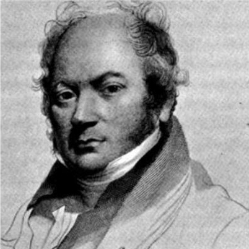
Born: 23 June 1766, London, England
Died: 8 March 1833, London, England
Nationality: English
John Thomas Smith, also known as Antiquity Smith, was an English painter, engraver, antiquarian, and writer. He was keeper of prints at the British Museum.
John Thomas Smith
A Book For a Rainy Day; Or, Recollections of the Events of the Last Sixty-Six Years
Richard Bentley, 1845.
1772...When we had crossed the New Road [Marylebone Road], there was a turnstile...at the entrance of a meadow leading to a little old public house, the sign of the "Queen's Head and Artichoke"...A little beyond...was another turnstile opening also into fields, over which we walked to the "Jew's-Harp House, Tavern and Tea Gardens"...Willans Farm, the extent of my mother's walk, stood at about a quarter of a mile south; and I remember that the room in which she sat to take the milk was called "Queen Elizabeth's Kitchen", and that there was some stained glass in the windows
The author, Keeper of Prints and Drawings in the British Museum, was a small child living at 7 Great Portland Street when he accompanied his mother on early morning walks 'to take milk at the cow-house', as advised by her doctor.
The carriage and principal entrance to Marylebone Gardens was in High Street; the back entrance was from the fields, beyond which, north, was a narrow winding passage, with garden-palings on either side, leading into High Street. In this passage were numerous openings into small gardens divided for the recreation of various cockney florists, their wives, children and Sunday smoking visitors...I well remember my grandmother taking me through this passage to Marylebone Gardens, to see the fireworks, and thinking them prodigiously grand
On pages 40-58 Smith lists a number of 'notices' of the Gardens that he had collected, forming a potted history of the entertainments from 1718 to 1776. There is also a reminder of the dangers visitors could face. In 1746 robberies were so frequent that the proprietor was obliged to have a guard of soldiers to protect the company to and from London, and as late as 1760 a reward of ten guineas was offered for the apprehension of any highwayman found on the road to the Gardens.
Nollekens and His Times
1828. Century Hutchinson, 1986.
One Sunday morning Mr. Nollekens took me to see the boys bathe in Mary-le-bone basin. As we were going, our attention was engaged by the beadles of the parish seizing the clothes of the lads who had gone into the small pond called "Cockney ladle," supplied with water by an arm which looked like a ladle from the basin...The basin - which was a very large, circular, and deep pond, fatal to many an inexperienced youth - was farther in the fields on the site of part of Portland-Place and Mansfield-street
The author was an 'early pupil and assistant of the great sculptor,' and was 'kindly invited' into Joseph Nollekens's studio in 1779, when he was 13. The bathing incident is not dated.
The Orchestra of Mary-le-bone Gardens, before which I have listened with my grandmother to hear Tommy Lowe sing, stood upon the site of the house now 17, in Devonshire Place, and very near where Mr. Fountain's Boarding-school* stood, nearly opposite to the old Church, still standing in High-street.
* Mr. Fountain [the Rev. John Fountayne], who succeeded Mr. De La Place in this school, was once walking with Handel round Mary-le-bone Gardens, and, upon hearing music which he could not understand, observed to Handel, "This is d-d stuff!" "It may be d-d stuff, but it is mine," rejoined Handel
This was a popular anecdote of the time; a fuller version is given by Fountayne's grandson. 'One evening, as my grandfather and Handel were walking together and alone, a new piece was struck up by the band. "Come Mr. Fountayne," said Handel, "let us sit down and listen to the piece - I want to know your opinion of it." Down they sat, and after some time the old parson, turning to his companion, said, "It is not worth listening to - it's very poor stuff." "You are right, Mr. F.," said Handel," it is very poor stuff - I thought so myself when I had finished it."' (Letter from Norrison Scatcherd in Thomas Hone's Year Book of 1832.)
The Fountayne family appear in another oft-told tale, one concerning a less respectable visitor. 'Another frequenter of the Gardens was the dashing and not unchivalrous Dick Turpin, who is said to have snatched a kiss in the open from the Reverend Dr. Fountaine's niece. When she shrieked, half in terror and half in indignation, he is credited with the rejoinder, nicely suited to his image: "Pray alarm yourself not, Madame. You can now boast that you have been kissed by Dick Turpin!"' (Gordon Mackenzie, Marylebone, Great City North of Oxford Street. Macmillan, 1972.)