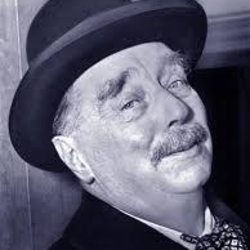
Born: 21 September 1866, Bromley, Kent, England
Died: 13 August 1946, London, England
Nationality: English
H. G. Wells was an English novelist, journalist, sociologist and historian, best known for works of scientific romance including The Time Machine and The War of the Worlds.
H. G. Wells
Select Conversations With an Uncle
John Lane, 1895.
Lived at 13 Hanover Terrace from 1937 until his death in 1946. Select Conversations With an Uncle is a collection of humorous articles written for the Pall Mall Gazette.
The Man With a Nose recounts a conversation between two men 'sitting, one at either end, on that seat on the stony summit of Primrose Hill which looks towards Regent’s Park. The paths on the slope below were dotted out by yellow lamps; the Albert-road was a line of faintly luminous pale green - the tint of gaslight seen among trees; beyond, the park lay black and mysterious, and still further, a yellow mist beneath and a coppery hue in the sky above marked the blaze of the Marylebone thoroughfares'.
The Great Change recounts a conversation about marriage as uncle and nephew walk through the zoo: 'He gave the bachelor wart hog a parting dig, and we walked slowly and silently through the zebra-house towards the elephants'.
Under the Knife
1896. Reprinted in The Complete Short Stories of H.G. Wells. J.M. Dent, 1998.
I was suddenly brought back to reality by an imminent collision with the butcher-boy's tray. I found that I was crossing the bridge over the Regent's Park Canal, which runs parallel with that in the Zoological Gardens. The boy in blue had been looking over his shoulder at a black barge advancing slowly, towed by a gaunt white horse. In the Gardens a nurse was leading three happy little children over the bridge. The trees were bright green; the spring hopefulness was still unstained by the dusts of summer; the sky in the water was bright and clear, but broken by long waves, by quivering bands of black, as the barge drove through. The breeze was stirring; but it did not stir me as the spring breeze used to do
Obsessed by a presentiment of death regarding his forthcoming operation, the narrator feels 'isolated from the life and existence about me. The children playing in the sun and gathering strength and experience for the business of life, the park-keeper gossiping with a nursemaid, the nursing mother, the young couple intent upon each other as they passed me, the trees by the wayside spreading new pleading leaves to the sunlight, the stir in their branches - I had been part of it all, but I had nearly done with it now.'
The Invisible Man
1897. Pan Books, 1987.
At last I found myself sitting in the sunshine and feeling very ill and strange, on the summit of Primrose Hill...All I could think clearly was that the thing had to be carried through; the fixed idea still ruled me.
After a successful experiment on a neighbour's cat, Griffin has walked from his lodgings near Great Portland Street to meditate on his next steps. 'I looked about me at the hillside, with children playing and girls watching them, and tried to think of all the fantastic advantages an invisible man would have in the world'.
The War of the Worlds
1898. Heinemann, 1968.
As I emerged from the top of Baker Street, I saw far away over the trees in the clearness of the sunset the hood of the Martian giant from which the howling proceeded
This unwelcome visitor - 'a walking engine of glittering metal' - was to make Regent's Park famous around the world (the book has been translated into more than twenty languages). It seems to be immobilized, but the narrator, who has witnessed the destruction it can cause, gives it a wide berth and heads up Park Road.
Far away, through a gap in the trees, I saw a second Martian, motionless as the first, standing in the park towards the Zoological Gardens, and silent...I came upon the Red Weed again, and found Regent’s Canal a spongy mass of dark red vegetation
Primrose Hill has been made into a 'huge redoubt' by the Martians, and is now full of their corpses. They have succumbed to bacteria that humans have long been immune to.
The novel was parodied as The War of the Wenuses - see the Pozzuoli entry, and (retaining the English locations) has been set to music - see Wayne.
Ann Veronica
1909. Virago, 1990.
The heroine is a student at the 'Central Imperial College' near Great Portland Street and there are several visits to the park to sit and think, walk across on her way home, walk around the Zoo with a biologist she is in love with and finally to break off her engagement to a civil servant over strawberries and cream at a pavilion. Little in the way of description though.
You Can't Be Too Careful
Secker & Warburg, 1941.
Sheep he was inclined to bully and run after, until one dreadful day in Regent's Park an old ram suddenly turned on him and stamped and stood his ground. Whereupon he fled screaming to his mother, who...confronted the danger and disposed of it very rapidly by opening and shutting her grey and white parasol
Edward Albert, born 1901, lives much of his life in the vicinity of the park. It is the venue for a school cricket match, and a discussion with his fiancée about their forthcoming marriage. Shortly afterwards he returns there to ponder on the debacle of 'the cardinal moment of their sexual lives'.