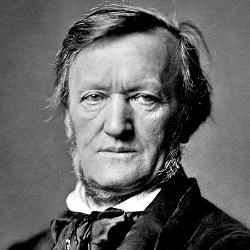
Born: 22 May 1813, Leipzig, Germany
Died: 13 February 1883, Venice, Italy
Nationality: German
Richard Wagner was a German composer, theatre director and writer whose operas and music dramas transformed nineteenth-century music and theatre.
Richard Wagner
My Life
Trans. Andrew Gray, ed. Mary Whittall. Cambridge University Press, 1983.
Arriving on March 2nd [1855] in London, I turned first of all to Ferdinand Praeger...established in London for many years as a music teacher...After spending the first night in his house, I found with his help the following day a nice place to stay in Portland Terrace in the neighbourhood of Regent's Park, of which I had pleasant recollections from my past visit. I thought my stay there would certainly prove agreeable, considering the expected onset of spring and the immediate proximity of that part of the park where the paths were shadowed by beautiful copper beeches. Although I spent four months in London, the spring never seemed to appear; the foggy climate weighed heavily on all the impressions I received there.
The composer had been invited to London to conduct a series of concerts. Praeger had been introduced by friends; Wagner thought him 'an unusually considerate fellow, yet a bit over-excited for the level of his education.' The over-excitement seems to have infected his memoir, Wagner As I Knew Him (Longmans Green, 1892), making it an untrustworthy source for biographers, but his account of visits to the park is too good to exclude.
Wagner As I Knew Him
Ferdinand Praeger. Longmans Green, 1892.
Part of Wagner's daily constitutional was to the Regent's Park, entering by the Hanover Gate. There, at the small bridge over the ornamental water, would he stand regularly and feed the ducks, having previously provided himself with a number of French rolls - rolls ordered each day for the occasion. There was a swan, too, that came in for much of Wagner's affection. It was a regal bird, and fit, as the master said, to draw the chariot of Lohengrin. The childlike happiness, full to overflowing, with which this innocent occupation filled Wagner, was an impressive sight never to be forgotten. His genuine affection for the brute creation, united to a keen power of observation, gave birth to numberless anecdotes, and the account of the Regent's Park peregrinations often formed a most pleasant subject of after-dinner conversation