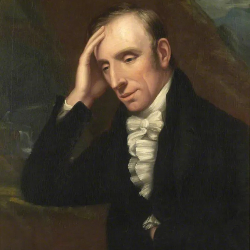
Born: 7 April 1770, Cockermouth, Cumberland, England
Died: 23 April 1850, Rydal Mount, Westmorland, England
Nationality: English
William Wordsworth was an English Romantic poet whose Lyrical Ballads, written with Samuel Taylor Coleridge, helped launch English Romanticism.
William Wordsworth
The Letters of William and Dorothy Wordsworth
Vol. 8. A Supplement of New Letters, ed. Alan G. Hill. Clarendon, 1993.
4-5 June, 1812...On Sunday morning [30th May] I had a most pleasant walk with Henry Robinson through the fields and over Primrose Hill to High-gate; we crossed the intended Prince Regent's Park at Mary bone which will be of vast extent, but the ground has in itself no variety for it is a dead flat, but it will have agreeable views from certain parts of Hampstead and High-gate hills
In a letter to his sister Dorothy, the poet recounts a visit to the playwright and poet Joanna Baillie. At her home he met an old acquaintance who was now Solicitor to the Excise. Together they 'conversed nearly an hour upon politics and alarmed each other not a little by the mutual communication of thoughts and observations.'
There was much to be alarmed about. Abroad, the country was at war with Napoleon and was shortly to find itself at war with America. At home, the assassination of the Prime Minister was feared to be the signal for a general uprising. Luddites in the distressed Midlands were attacking the factories and smashing the machines that were destroying their livelihood. Byron wrote 'A Song for the Luddites' - 'We will die fighting, or live free' - and spoke in their defence in the House of Lords; Wordsworth would have seen them as the enemy. He had long since withdrawn from the radical stance of his youth, when he had greeted the French Revolution with 'Bliss was it in that dawn to be alive'.
Even so, he was appalled by the Prince Regent, whose 'conduct is described to be capricious and unprincipled in the extreme; and he does not appear to have the slightest strain of common human feelings'. Leigh Hunt had expressed similar sentiments two months earlier, but as he had published them in The Examiner he was sent to jail for it.